Critically assess the contribution that public relations can make to marketing communications.
Harvard Style, University Level Essay

Contribution of Public Relations to Marketing Communications
In 1936, the GPO Film Unit produced a documentary film titled ‘Night mail’, about the overnight mail train service from London to Scotland. Made with an intention of improving internal communications as well as external publicity, the film quickly gained an iconic status and continued to be used by companies as an internal communications tool in the 1950s and 1960s.

This marked the birth of the ‘Documentary Film Movement’ in Britain, led by John Grierson, who believed that educational films could, “Do something to bridge the gap between the citizen and the wide world” (Grierson Archive, G4:19:21, p.3). And the movement brought about the introduction of the concept of Public Relations (PR), with number of other vital political and social influences that facilitated its growth.
Since then, PR and Marketing have undergone a complete make-over as concepts worldwide. In 2001 the United Parcel Service (UPS) admitted to making a mistake that led to a public relation fiasco. As an outcome of a marketing gimmick gone wrong, 200,000 of its customers had their browsers reprogrammed without their consent, which affected some of UPS’s most loyal customers.
This is to say that the contribution of PR to Marketing Communications (Marcomm) depends on choosing the right ‘communication mix’ after carefully studying the ‘marketing mix’.
Marketing Mix – In Changing Times
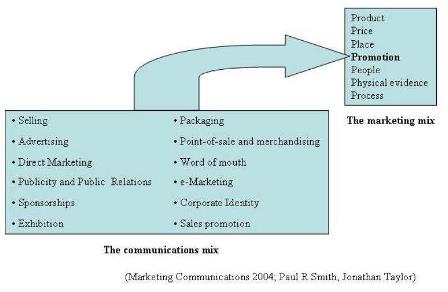
Marketing mix is a conceptual framework that helps in structuring an approach to each marketing challenge. There are different approaches to the marketing mix such as 4Ps, 5Ps and 7Ps. Communication mix can also be referred to as the ‘Promotional Mix’, which entails all the communication tools available to the marketer to promote the product or service.
How The Communication Mix Feeds Into The Marketing Mix
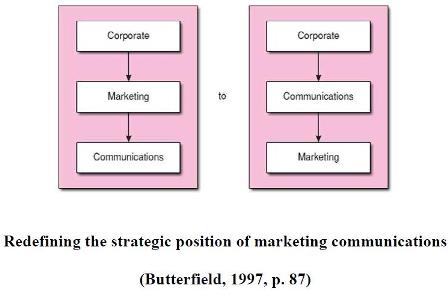
Traditionally, the conventional marketing model placed communications alongside the other variables of the marketing mix. It viewed marketing communications to be a subset of a company’s marketing strategy, which in turn is a part of corporate strategy. However, this model failed to take into account the growing importance of‘communication’ and the ‘complexity of the contemporary consumer behavior’. Noting this, Butterfield suggested a ‘new model’ of planning, which placed marketing as a part of the ‘delivery mechanism’ for the communications strategy.
Hence, marketing communications can be defined as “the means by which a supplier of goods, services, values and/or ideas represent themselves to their target audience with the goal of stimulating dialog leading to better commercial or other relationships” (John Egan, 2007). The ‘new model’ does not, however, imply that every marketing communication is involuntarily elevated to a strategic role. To understand this, one must understand the distinction between ‘Product PR’ and ‘Corporate PR’.
Product PR + Corporate PR = Right PR Mix
Traditionally, marketing focused on three publics – the customers, distributors and the competition. However, PR deals with many more publics, explains Financial Times, that ‘both management and unions of a company, before embarking on any dispute, must ask: How will this play in the media?’
Essentially, Product PR focuses on the ‘product or brand publicity’, whereas Corporate PR on ‘corporate image enhancement’. In an interesting interpretation Norman Hart (2002) observed that PR could be more of a corporate activity, such as corporate communication, rather than a product activity, such as product publicity.
According to UK’s Institute of Public Relations (IPR), Public Relations can be defined as, “The planned and sustained effort to establish and maintain goodwill and mutual understanding between and organization and its publics.” PR services typically include media relations, crisis management, writing and feature placement, press materials and collateral, media tours, newsletters and e-newsletters, product introductions, special events, trade shows, high-technology marketing, employee communications, financial/investor relations and media training.
But in the digital age when it comes to dealing with the Generation C – those millions of individuals who are publishing their views and ideas on the web, PR holds a significant position. In this case, PR becomes essential in exhibiting a unified company image to these millions of fragmented groups. This calls for an integration of the external and internal marketing communications, a term commonly referred to as Integrated Marketing Communications (IMC). IMC can be defined as, “a customer-centric, data-driven method of communicating with the consumers” (The Journal of Integrated Marketing Communications, 2010).
However, reactions to the concept of IMC remain mixed amongst the PR practitioners. Jack O’Dwyer (1995) observes, “Some PR people feel threatened by the thought of working closely with advertising, direct mail, sales promotion, and database marketing specialists. But other PR pros are rushing out to meet these fellow communicators, saying IMC is client driven and PR people had better get on the bandwagon if they hope to keep their jobs”. In October 1982, Johnson & Johnson (J&J) faced a tremendous crisis when seven people in Chicago were reported dead after consuming one of its leading brands, the Tylenol. A market share of 37%, controlled by the Tylenol, came down to 7% after the incident (Mitchell, 1989). The product was immediately removed from the market, after warning the public about the consumption of the product. J&J launched a campaign to reintroduce its product and restore the confidence of the consumers. The most effective PR tool proved to be J&J’s responsibility to its publics first.
According to Thomas Harris (The Marketer’s Guide to Public Relations, 2006), it is in the best interests of a corporation to consider marketing and PR as the same function.
PR & The Media
In the age of Globalisation, the media has come to play a very strategic role in building PR. ‘Editorial publicity’ has come to gain grounds, with the commercial news items and features being the work of a skilled PR professional. It is different from advertising for three reasons – relatively inexpensive, high credibility and, no control over the message.
While a low media cost and high credibility add to the advantage of editorial publicity, one of its drawback lies in the fact that it can’t be controlled. An editorial can be replaced at the last moment by any other more important news item. In case of a news release, it is possible that while one newspaper gives it a brief but positive coverage, another treats it with a lot of cynicism, leading to a negative editorial coverage. Carefully controlled media events, such as annual general meetings can go wrong too, if not properly handled. The argument that all publicity can be good publicity does not always hold true. Retail jewellery giant Ratners had to learn this the hard way when their chairman, Gerald Ratner, told the press that his jewellery was ‘crap’. The news gained national coverage but it also kept the customers away from his shops, eventually dipping the employee morale.
Press Releases – In Changing Times
“To bypass the media, think like they do … You will need to be a maverick.”
– David Meerman Scott (New Rules of PR, 2006)
Scott explains in his book that gone are the days when a press release, shockingly, was just a release to the press. Companies needed to have significant news on them before they were allowed to write press releases, which had to include third-party quotes by customers, analysts and experts in them.
Except for a handful of reporters and editors nobody could get to see the actual press release. The only way for buyers to know about the content of a press release was if the media wrote on it. The effectiveness of a press release depended entirely on the media. But the media today has been “disintermediated” (Scott, 2006). The audience has expanded from hundreds of journalists to millions of people with access to the Internet. This has dramatically increased the effectiveness of the press release as a ‘direct consumer-communication channel’. Press releases sent over the wires appear in near real-time on services like Google News and buyers get to read them directly. The ‘new rules’ include finding a good reason to send out big news all the time. Nonetheless it does not diminish the importance of media relations, with the trade press
and mainstream media being a part of an overall communications strategy.
PR for Crisis Management
The value of sound PR in helping the people and communities they serve to cope during times of life threatening crisis, came to the fore during the 9/11 crisis. “Without a doubt, 9/11 was the biggest PR effort in history for public officials and public servants. For obvious reasons, the bulk of PR activity was done with the media,” notes Don Bates (2006), adding, “Probably the biggest PR job of 9/11 was the work that government agencies, both local and national, did to inform the citizenry about what was happening in the wake of the deadly attacks while trying mightily to minimize the potential for public panic.”
On the day, Merrill Lynch (ML) set up ‘crisis response offices’ for employees and investors and started various internal and external web sites for disseminating information and reporting operational status. One urgent problem was to dispel the rumor in the media that the ML headquarters building was about to collapse. Company executives went on major news shows to inform the public about the financial impact of the attacks, and several daily press releases were distributed by company communicators. Commenting on the role of PR professionals during and after the 9/11 tragedy, the editor of Strategist wrote, “The events of Sept. 11 didn’t necessarily precipitate a huge change in the way communications leaders do their jobs. Rather, they accelerated the speed of existing trends to decentralize, install better backup technology, and pay more attention to employee concerns. The new irony of crisis communications is we must expect the unexpected – and be ready for it when it happens.”
PR & Marcomm – The Right Mix
In PR, the key to long-term success for any company is to first develop a solid platform of ‘credibility’, before focusing on visibility and publicity (Smith, Paul. R, 2004). This means that the quality of a product or service must match the promise made by marketing communications. This should be followed by increasing ‘visibility’ by undertaking publicity-generating activities such as publicity stunts, news releases, conferences, exhibitions, events, sales promotions, sponsorship etc.
An interesting example would be the Harry Potter’s invisible PR (Brown, 2001). Before its launch, review copies were withheld from interviews and hints were dropped about a ‘limited stock’. Twenty advance copies were ‘accidentally’ sold out by a Wal-Mart in West Virginia, and one of the ‘lucky kids’ was tracked down by the media and splashed across every front page of the newspapers – an anti-marketing strategy that built up the PR hype.
Another example was the strategy adopted by Phelps Group for the launch of IndyMac Bank in a cluttered category where there was a major bank on every street corner. They capitalized on IndyMac Bank’s technological superiority and cost efficiencies to attract accounts by offering higher CD and Money Market Savings rates, utilising the theme ‘Bureaucracy Beware’ to herald a new kind of bank where service still counts. From July, 2000 to July, 2001, the Consumer Bank grew 465% and by the end of May, 2001, it had already exceeded their 2001 year-end goals (Phelps, 2002).
In order to sustain the visibility created by PR professionals, various advertising campaigns are followed by press launches and publicity campaigns nowadays. An integrated packaging, involving PR and Sales Promotion can help uphold a brand’s share without any conventional above-the-line support. At exhibitions and trade fairs, blown-up press cuttings can look effective. Third-party endorsements can be used in news releases, advertising, sales promotion, packaging design etc. Ideally, each marketing activity should be planned for maximum integration – rather than pulling in different directions, the marketing communication tools should work together.
Traditionally, the conventional marketing model placed communications alongside the other variables of the marketing mix. It viewed marketing communications to be a subset of a company’s marketing strategy, which in turn is a part of corporate strategy. However, this model failed to take into account the growing importance of‘communication’ and the ‘complexity of the contemporary consumer behavior’. Noting this, Butterfield suggested a ‘new model’ of planning, which placed marketing as a part of the ‘delivery mechanism’ for the communications strategy.
REFERENCES
1) Bates, Don. (2002). Mini-Me History- Public Relations from the Dawn of Civilization. Institute for Public Relations.
2) Prejean-Motanky, Renée A. (2003). In the world of integrated marketing, what role does Public Relations play in today’s mix? Publicity Club of Chicago.
3) Butterfield, J. (1997) ‘Strategy Development’ in Butterfield, L. (ed.) (1997) Excellence in Advertising, Oxford Institute of Practitioners in
Advertising/Butterworth Heinemann pp. 65–90.
4) James E. Grunig (2009) Paradigms of global public relations in an age of digitalization. University of Maryland.
5) Yang, S. U. (2007). An integrated model for organization-public relational outcomes, organizational reputation, and their antecedents. Journal of Public Relations Research, 19, 91-121.
6) Harris, Thomas L. (2006). The Marketer’s Guide to Public Relations.
7) Smith, Paul. R. Taylor, Jonathan. (2004). Marketing Communications: An Integrated Approach
8) L’Etang, Dr. Jacqui. (1999). John Grierson and the public relations industry in Britain
9) Schorah, Keith. (2002). The Role of Public Relations in the Marketing Mix. Bizzcommunity.com.
10) Scott, David M. (2010). The New Rules of Marketing and PR11. Bernays, Edward. (1928) Propaganda.
11) Egan, John (2007). “Introduction”. Marketing communications. p. 1.
12) O’Dwyer, Jack. (January, 1995). O’Dwyer’s PR Services Report, Volume 9
13) Phelps, Joe. (2002). Pyramids Are Tombs: Case Histories – IndyMac Bank
14) “Deifnition of Integrated Marketing Communications”. The Journal of Integrated Marketing Communications. Dept. of Integrated Marketing Communications.
15) Sriramesh, K. (2009). Globalisation and public relations: The past, present, and the future. Massey University, Wellington, New Zealand
16) Hart, Norman. (1992). Implementing An Integrated Marketing Communications Strategy: Is there a new role for PR in Marketing?..
17) Sison, M. D. (2009). Whose cultural values? Exploring public relations’ approaches to understanding audiences. RMIT University, Australia.


Leave a Reply