1) What are, and how do common resources and capabilities link the different Virgin companies?
Brand, or intellectual property, an intangible resource, is Virgin’s strongest resource, which has strengthened under the visionary leadership of Richard Branson – founder of the Virgin Group, and its’ first, tangible resource (Grant, 2010; Mihailovic, 1995; Rothacher, 2004). Third, is an intangible resource – intellectual capital, or knowledge, or sector expertise – aided by Branson’s vision and the support of an “incredible team” (Branson, 2017). Thus, human resource, or network, or management, or people – is the fourth, tangible resource (“Our Senior Team”, n.d.; Grant, 2016). An unstructured, “holocratic” organizational structure, – shaped by an informal, people-centric, adventurous work culture – is the fifth, intangible resource (Kamasak, 2017; “Tearing up the”, 2015; Branson, 2017). Finally, technology is a resource which Virgin has acquired by renewing its dynamic capabilities (Ambrosini et al., 2009).
Branson’s identity as a business incubator lends Virgin its capability of entrepreneurship, executed by Virgin’s role as a ‘branded venture capital’ (Boje, & Smith, 2010; “Venture Capital”, n.d.). Diversification, disruption, and innovation – are three distinct capabilities, linked to Branson’s risk-taking capability (Branson, 1985). Virgin’s scale of diversification is regarded a rare success story (Robert, 2004; Altman, 2009). Virgin creates disruption in monopolistic markets through price and quality differentiation (Mihailovic, 1995; Grant, 2016; Branson, 2019). Innovation, a dynamic capability, is recognised as Virgin’s core competency (Tucker, 2001; Lindgardt et al., 2009; Kim & Maubourge, 1997). Virgin’s capabilities in marketing are often backed by Branson’s promotional publicity (Collinson & Shaw, 2001; Bridgewater & Doyle, 1998; Balmer, 1998; Maklan & Knox, 1998). The capabilities of management – of knowledge, customer relationship, and the company – leverage Virgin’s overall performance management (Newman, 1997; Vries, 1999; Buttle, 1999; Sealey, 1999). Finally, the capabilities of delivering a “peerless” customer service make Virgin a “consumer champion” (Upshaw & Taylor, 2013; Kim & Mauborgne 2004; Weinstein, 2012).
2) Discuss and evaluate Virgin’s various diversification moves in terms of related and unrelated strategies.
The fact that Virgin exemplifies an “institutionalised permanent risk” is partly due to its success in unrelated diversification (Halpern & Graham, 2018; Rothacher, 2004). However, the critiques of Ansoff Matrix – regarding the importance of ‘strategic commonalities’ over ‘market commonalities’ – are validated in a globalised world as distinctions between related and unrelated markets shrink, and the relatedness between Virgin’s shared tasks becomes apparent (Markowitz, 1952; Dawes, 2018; Ansoff, 1957; Markides & Williamson, 1994).
Presently, a dynamic space industry is witnessing a booming space economy of which Virgin Galactic is an important catalyst – leading in space tourism, satellite internet, and small satellite launch services market (Berrisford, 2018). Virgin’s investments in Boom technology may bear slow returns, owing to the engineering and regulatory challenges facing supersonic air travel (Adams, 2019). Virgin Atlantic’s codeshare partnerships and acquisitions will leverage its presence in the transatlantic market (CAPA, 2019; Jo, 2019; Baxter, 2019). Its success with biofuel flights will boost U.K.’s sustainable aviation fuel market, though challenges of collective action remain (Aviation, 2014; Higham et al., 2018). Hyperloop One’s prototype is in line with the futuristic ‘Smart City’ infrastructure (Pelton & Singh, 2019; TR News, 2018). Although Virgin Trains U.K. is disqualified from franchise bidding, it can look to other investment avenues in the growing U.K. rail industry (Caplan, 2019; Branson, 2019).
The challenge of changing consumer perception which faces Virgin Trains U.S.A., America’s first high-speed rail, can be met through cross-promotion with Virgin Voyages and Virgin Hotels, and a seamless physical-digital – ‘phygital’ – integration of infrastructure (Carey, 2019; Nemtanu & Marinov, 2019). The Project Lightning programme, and AdSmart and Tameside partnerships, will leverage Virgin Media’s supply chain to service future IoT-based smart cities (Virgin Media, 2019; Weber & Žarko, 2019). The MVNO technology, which Virgin pioneered, has the potential to better serve the lifestyle and entertainment industry (Grimaldo, 2018).
Given the criticism of the state of healthcare in U.K., the N.H.S., and its stressful history with Virgin Care, the time is perfect for Virgin to redeem itself through new models of care as analysts tout N.H.S. to gain from Brexit (Earle, 2018; Bevir & Waring, 2017; McKee & Martin, 2016; Britnell, 2018). Of all the sectors, Virgin’s contribution is probably the weakest in entertainment – films, music, games, casino, books etc. Its ‘impact investments’ – in sustainability, entrepreneurship, gender equality, diversity – are in line with an increasing global consciousness (“How Virgin Money”, n.d.; “How Virgin Holidays”, n.d.; Viviani & Maurel, 2019).
3) Assess whether moving further into the banking industry is the right strategic option for the Virgin Group (Apply Porter’s 5 Forces and 3Ps).
Porter’s 5 Forces • Buyer Power – Trust – is the incentive that CYBG can offer SME customers who are reluctant to bank-switching (Kervinen, 2019). The challenges include increasing customer awareness towards Open Banking and changing consumer behaviour towards their traditional preferences for ATMs, branches, and cash (MHPC, 2018; Dallerup et al., 2018; Maison, 2019). • Supplier Power – Virgin Money’s acquisition by CYBG is recognised as a strategic consolidation, making it the leading ‘challenger bank’ to the Big Four (French et al., 2013; “CYBG completes”, 2018; “CYBG buys Virgin”, 2018). Upgradation of CYBG’s credit ratings points to its potential for disruption (Dyer, 2019; Jones, 2018). • Barriers to Entry – The PSD2 regulations for Open Banking, new legislative framework of MiFID II and MiFIR, and Temporary Permissions Regime (TPR) in case of a hard-Brexit – all stand to create a level playing field for new banks. Virgin’s geographically diversified portfolio will be able to offset many risks posed by Brexit. • Threat of Substitute Products – With the rise of specialists, substitute products are now regarded as complementary, rather than a threat to traditional banking. Processes should embrace concepts of lifestyle banking, mobile banking apps, digital wallet, sustainability banking, relationship banking (Terrizzano et al., 2018; Alexander, 2019; Vargha, 2018). • Rivalry Among Firms in the Industry – The biggest competitors are the ‘Big Four’ banks – Barclays, HSBC, Lloyds Banking Group, and The Royal Bank of Scotland Group, specialist lenders, and other challenger banks (Hussain, 2019). Analysts note the laggardness of the CMA9 collective of retail banks in implementing the Open Banking standard by CMA (“Open Banking year”, 2019).
3Ps • People – Human resource management will involve attracting talent, developing employees’ digital skills tailored for analog banking, business intelligence, and AI, and providing a positive environment for a multigenerational workforce (Raftery, 2017; Tuite, 2019). • Process – Traditional banking demands integration of present fintech technologies like Application Programming Interface (API), open banking, social trading, robo-advisors (AI), blockchain, cryptocurrency, data analytics, Personal Finance Management (PFM), chatbots, and mobile banking. Gamification, simplification, transparency, and security – of the processes, will add value (Bayuk, 2019; Beatty, 2019). • Physical Evidence – Paperless, cashless, branchless banking will give way to newer concepts, of – Café Branch, and Smart Branch technologies like banker tablet, interactive teller machine, video conferencing rooms, service terminals, teller cash recycler, robot host (Dallerup et al., 2018).
4) What would be the challenges faced by a successor to Sir Richard Branson, and focusing on corporate strategy, what might he or she do?
Transitional, delicate global economy and uncertain geopolitics pose systematic market risks (Behravesh, 2019; Spence, 2019). However, the recent political developments in Britain, and a clean Brexit, can prevent an imminent national crisis (“Theresa May takes”, 2019; Halligan & Lyons, 2018).
Establishing and communicating the correlation between transport, health, and sustainability is essential to avoid past policy mistakes (Cavoli et al., 2015; Maas et al., 2006). Sustainability, or health, is thus a long term challenge. For Virgin, it means integrating its ‘People & Planet’ portfolio with ‘Health & Wellness’ (“Find a Virgin”, n.d.). A marketing strategy involves designing messages where “health is fun”, using health entertainment, e-health, telehealth – to evoke collective action (Wang & Kent, 2012).
Digitalisation and cybersecurity pose challenges of integration (Gann et al., 2011). Strategic M&A can trade-off Virgin’s risks of investing in competing technologies – digitally interconnected green mobility networks (Wang et al., 2013; Mezghani & Aloulou, 2019; Strasser & Albayrak, 2015; Wang & Kent; 2012).
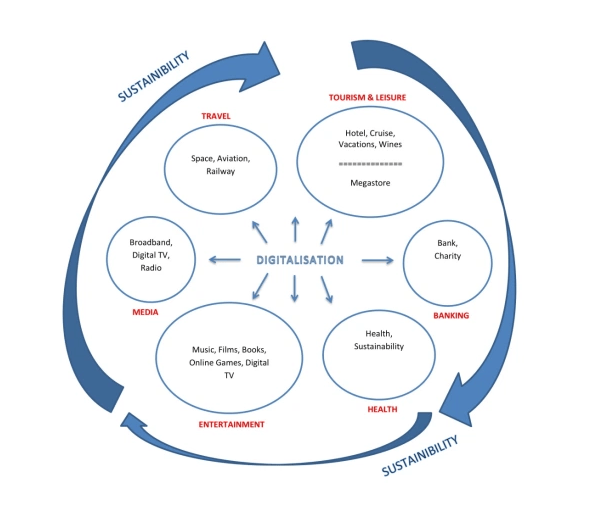
Paradoxically, much literature points towards both an appreciation of Virgin’s unstructured organisation, and a need for restructuring (Vries, 1999; Grant 2016). Figure 1 illustrates an example of a restructured model of Virgin’s core and sub-sectors, and their interplay with digitalisation and sustainability. A “New Work Order” in an eco-friendly digital economy will demand and yield innovative business models (Gee, 2018; Bocken et al., 2019; Westerlund et al., 2014). Virgin’s experience can contribute to the R&D – of correlations between corporate restructuring and performance, and of business models innovations (Singh, 1993; Lindgardt et al., 2009).
A company’s website is a crucial touchpoint in Integrated Marketing Communications (IMC). Virgin’s complex portfolio necessitates a simpler website design – through categorisation, archiving, labeling, and better navigation (Rosen & Purinton, 2004). Cross-promotion ideas may come from exploring the role of each sector and sub-sector within the other, for example, ‘space in television’ translates into Virgin Produced films about Virgin Galactic, while ‘television in space’ may include screening Virgin Produced films on SpaceShipTwo.
There is concern about the future of Virgin without Richard Branson (Grant, 2016). Herein is an opportunity to reconstruct leadership roles (Western, 2019; Kelly, 2019). It involves preparing – employees, stakeholders, customers, and masses – for a leader transition, determining the future role of the exiting leader, and exploiting the advantage of this “shifting cohort” (Kunreuther et al., 2013). The challenges faced by the Virgin Group, Richard Branson, and his successor – are the same. The strategy is to continue their purpose of ‘changing business for good’ (“Our Purpose”, n.d.).
References


Leave a Reply